Data and statistics verified as of: February 2026
Your procurement team looks busy. Every day they're answering emails, chasing suppliers for confirmations, updating spreadsheets, and manually entering data into your ERP. They look productive - but here's the uncomfortable truth: they're caught in a "chasing tax" that bleeds tens of thousands per buyer per year and exposes your operation to production shutdowns costing up to $500,000 per hour.
This isn't a productivity problem. It's a structural one. And most manufacturers don't even know how much it's costing them.
How Much Does PO Chasing Actually Cost Your Company?
Let's start with the numbers. According to the Bureau of Labor Statistics (May 2024), the median annual wage for buyers and purchasing agents is $75,650. In manufacturing specifically, that figure is $76,480. Add 25-30% for benefits and overhead, and you're looking at roughly $95,000-$100,000 in fully loaded cost per buyer.
But what portion of that salary goes to strategic work versus chasing emails?
Research from CAPS Research and ISM reveals a stark reality: 35% of procurement headcount is devoted to tactical buying activities, compared to just 22% for strategic buying. In their words: "Transactional buying is necessary, but it's a low-value activity. You're simply transacting a buy or passing the paper from one side of the desk to the other."
Let's do the math on the "chasing tax" per buyer:
| Cost Component | Calculation | Annual Cost |
|---|---|---|
| Base Salary (Manufacturing) | $76,480 | - |
| Benefits + Overhead (30%) | $76,480 × 0.30 | $22,944 |
| Total Employee Cost | - | $99,424 |
| Time on Tactical Work (35-50%) | $99,424 × 0.45 | $44,740 |
That's nearly $45,000 per year - per buyer - spent on low-value transactional activities. Multiply by a team of 3-5 buyers and you're looking at $135,000-$225,000 annually in what is essentially manual data entry.
The Hackett Group's 2025 research confirms the productivity gap: "Digital World Class" procurement teams deliver 2.6X greater ROI than peers while operating with 31% fewer full-time employees and at 19% lower cost. They achieve 58% shorter requisition-to-purchase-order cycle times and 24% shorter sourcing cycles.
The message is clear: top performers have automated the chasing. Everyone else is paying the tax.
What Is the True Cost of Late Parts?
The salary cost is visible on the P&L. The bigger cost is invisible until it's too late: production downtime.
When a critical part arrives late, the line stops. According to ABB's 2025 industrial research, 83% of industry decision makers agree that unplanned downtime costs a minimum of $10,000 per hour, with 76% estimating costs up to $500,000 per hour for large facilities.
The downstream effects multiply quickly:
- Expedited freight charges: Air cargo represents only a tiny fraction of total freight weight but accounts for 33% of global trade value - because it's used for "line-down" emergencies. Expedited shipping can cost 5-10x standard rates.
- Idle labor costs: Production workers sitting idle at $50-100 per worker per hour while waiting for parts.
- Overtime recovery: Teams scrambling to catch up at one-and-a-half to two times normal labor rates once parts arrive.
- Customer penalties: Modern supply contracts often include late delivery penalties ranging from one-and-a-half to five percent of contract value per month of delay.
A single line stoppage that could have been prevented by proactive supplier follow-up becomes a $20,000-$50,000 event. When it happens quarterly, you're looking at $80,000-$200,000 in entirely preventable costs.
The root cause? Buyers don't know a part is at risk until the supplier misses the delivery date - and by then, there's nothing left to do but expedite at premium cost.
Why Don't Supplier Portals Solve This Problem?
If manual chasing is so costly, why haven't supplier portals fixed it? The theory is simple: give suppliers a centralized dashboard to update delivery dates directly. Automated data sync, no more chasing.
The reality is different. According to TechnologyMatch's analysis: "Here's the truth most vendors won't tell you: 60%+ of supplier portal implementations fail to achieve their adoption goals."
Why? Because portals solve your problem, not theirs.
| Factor | Portal-Based Approach | Email-First AI (Sotro) |
|---|---|---|
| Supplier Adoption | 30-40% (average) | 100% (by design) |
| Supplier Onboarding | Required (complex) | None required |
| Supplier Behavior Change | Must learn new system | Continues using email |
| Cost for Supplier | Often involves fees | Completely free |
| Integration Effort | Heavy IT lift | CC workflow - instant |
The fundamental problem is the "many-to-many" relationship. A supplier serving 50 different customers might face 50 different portals - each with unique logins, interfaces, and workflows. For a supplier's lean staff, logging into 20+ portals daily is a non-starter. They revert to the lowest common denominator: email.
This leads to dismal adoption rates. Even 2 years after rolling out a portal, many companies find only 60-70% of suppliers actively use it. The rest keep emailing your buyers. Your team then manually inputs those emailed updates into the portal or ERP, defeating the entire purpose.
It's the worst of both worlds: you paid for portal software and buyers are still chasing emails from the stragglers. A tool that only works for 60% of your supply base isn't automation - it's a partial solution that creates more work, not less.
How Does Email-First AI Eliminate the Chasing Tax?
What if you stopped trying to change supplier behavior and worked with it instead?
Email-first AI recognizes that email is the universal language of B2B commerce. Rather than fighting supplier behavior, it wraps an intelligent layer around it. Here's how the Sotro approach works:
- Buyer CC's Sotro on the PO email (or uploads POs directly).
- Sotro extracts the PO details and creates a dedicated AI Agent for that order.
- The AI Agent monitors the order 24/7 - if no confirmation arrives within a set window, it drafts a polite follow-up.
- Supplier replies via email with delivery dates, partial shipment info, or delay notifications - exactly as they always have.
- Sotro parses the response using natural language processing, extracts the promised date, and updates your ERP automatically.
The supplier doesn't need to learn anything. They just reply to emails - business as usual. The difference: Sotro never forgets to follow up, never takes a day off, and processes responses in seconds instead of hours.
Because suppliers continue using email, adoption is effectively 100% from day one. No training webinars, no new passwords - they just reply to the PO email as they've always done.
The operational impact can be dramatic. According to Hackett Group research, best-in-class procurement organizations have cut requisition-to-purchase-order cycle times by 58% through automation. Instead of a buyer spending 15+ hours per week chasing 100 open POs, the AI agent monitors all of them continuously and surfaces only the exceptions that need human attention.
What Is Predictive Risk Detection?
Traditional procurement metrics like On-Time In-Full (OTIF) are backward-looking. They tell you that a supplier failed after the delivery date has already passed. By the time OTIF shows a problem, you've already got a line stoppage or expedite bill on your hands.
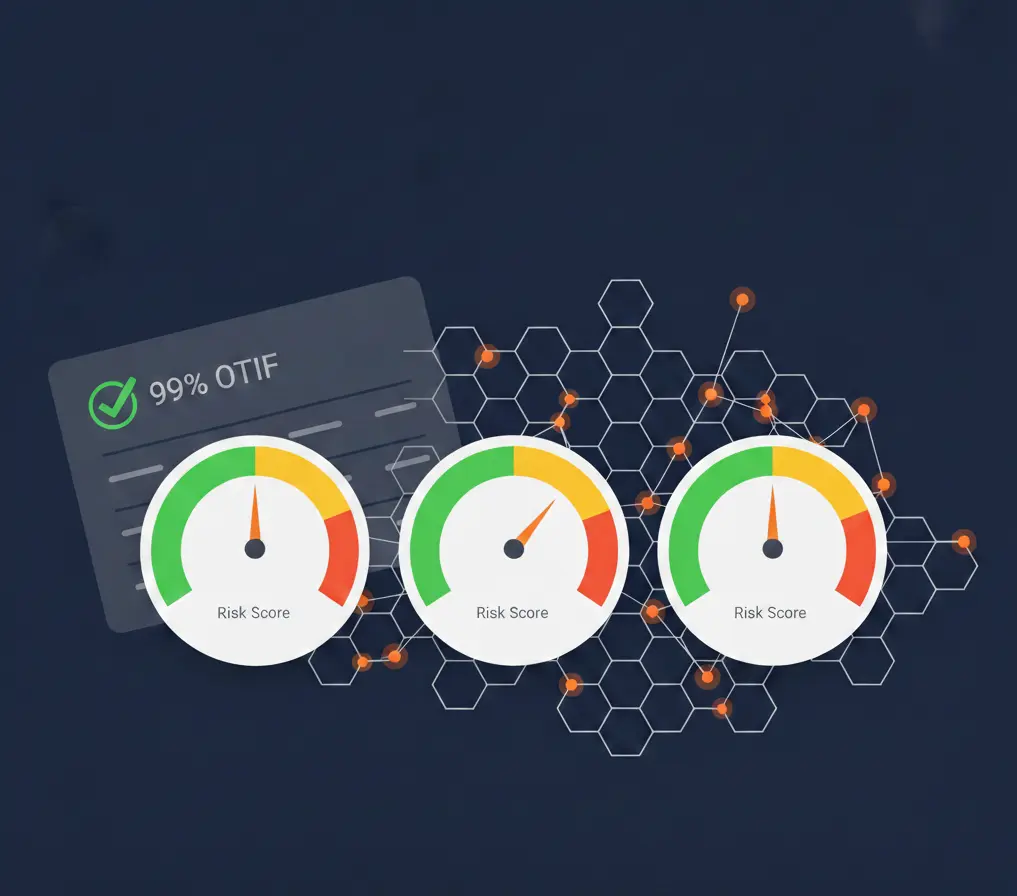
Sotro's Supplier Reliability Index (SRI) is predictive. It scores each open order based on the likelihood of delay - before the due date arrives.
SRI combines three data streams:
- Historical patterns: The AI analyzes past behavior of each supplier. Do they confirm and then slip schedules? Are certain part categories more prone to delay? If Supplier B has only hit promised dates 60% of the time historically, any new PO from them is automatically higher risk.
- Communication latency: A surprisingly predictive signal is how responsive a supplier is to communications. If a vendor consistently takes 10 days to acknowledge POs or is radio-silent until chased, that lack of responsiveness correlates with disorganization or capacity issues - a leading indicator of late delivery.
- Regional disruption signals: External data on weather events, labor strikes, port congestion, or geopolitical risks can raise the risk score of all orders from affected regions.
The output is an SRI score for each open order, recalculated nightly. A high SRI score means the AI suspects this PO is likely to be delayed unless action is taken. This gives your team a predictive dashboard - you know where to focus today, proactively, rather than reacting when something is overdue.
Compare this to OTIF: it would eventually tell you "10 POs arrived late last month." SRI tells you "these 5 POs are trending toward a late delivery next month - do something now." That's the difference between firefighting and fire prevention.
Manual Buyer vs. AI Agent: What's the ROI?
Let's put hard numbers to the comparison:
| Metric | Manual PO Management | AI-Driven (Sotro) |
|---|---|---|
| Supplier Response Rate | 60-70% via portal (rest still email) | 100% via email (instant adoption) |
| Buyer Hours on Follow-ups | 15-20 hours/week | 2-3 hours/week (exceptions only) |
| PO Confirmation Lead Time | 5-7 days (until chased) | <1 day (AI logs instantly) |
| Risk Detection | Reactive (after delay occurs) | Predictive (SRI flags before delay) |
| ERP Updates | Manual data entry | Automatic sync |
| 24/7 Coverage | No | Yes (nightly scans, global time zones) |
Now consider a manufacturer with 3 buyers managing 300 active POs:
| Scenario | Manual Process | With Sotro |
|---|---|---|
| Buyer Tactical Cost (45%) | 3 × $45,000 = $135,000/year | Reduced to 10% = $30,000 |
| Sotro License | - | ~$18,000/year |
| Labor Savings | - | $87,000/year |
| Downtime Incidents (4/year × $50k) | $200,000 | Reduced 60% = $80,000 |
| Downtime Savings | - | $120,000/year |
| Total Annual Impact | - | $207,000/year |
The Hackett Group reports that top-performing procurement organizations generate 2.03X greater cost savings as a percentage of spend by anticipating opportunities and maintaining the ability to renegotiate supply agreements. They experience 60% less savings lost due to reduced maverick buying and contract noncompliance.
The non-financial benefits compound the value: buyers freed from administrative drudgery can focus on supplier relationship management, strategic sourcing, and cost reduction initiatives. That's not just efficiency - it's competitive advantage.
Why Doesn't Every Manufacturer Do This?
Two reasons:
First, the cost of manual processes is invisible. Most manufacturers don't track the true cost of procurement friction. They see a $75,000 buyer salary but don't connect it to the $200,000 in annual downtime that late parts create. Finance doesn't link PO chasing to expedited freight costs. Operations doesn't trace line stoppages back to supplier confirmation failures. The costs are real, but distributed across different P&Ls, so nobody owns the problem.
Second, most procurement solutions were designed for large enterprises. SAP Ariba requires 18-24 months to implement and costs $500,000-$2M. Coupa demands expensive change management and portal adoption from hundreds of suppliers. For a 200-person manufacturer, these solutions are oversized, overpriced, and under-adopted.
Email-first AI is different because it doesn't require supplier behavior change, large implementation budgets, or years of rollout. It works with the workflows that already exist.
Frequently Asked Questions
How much does manual PO chasing cost per year?
Based on BLS data, the median buyer earns $75,650/year ($76,480 in manufacturing). With 30% overhead, fully loaded cost is ~$99,000. CAPS Research shows 35-50% of procurement time goes to tactical work, meaning $35,000-$50,000 per buyer annually is spent on low-value activities like email chasing and manual data entry.
What is the cost of production downtime from late parts?
According to ABB's industrial research, 83% of industry leaders report downtime costs a minimum of $10,000/hour, with 76% estimating up to $500,000/hour for large facilities. For mid-size manufacturers, a single day of unplanned downtime typically costs $50,000-$200,000 when factoring in idle labor, expedited freight, overtime recovery, and customer penalties.
Why don't supplier portals solve the PO chasing problem?
Over 60% of supplier portal implementations fail to achieve adoption goals because they solve the buyer's problem, not the supplier's. Suppliers face "portal fatigue" from managing logins to dozens of different customer systems. Even after 2 years, portal adoption typically plateaus at 60-70%, leaving the remaining suppliers on email - which still requires manual chasing.
What is the Supplier Reliability Index (SRI)?
SRI is Sotro's predictive risk metric for each open order. Unlike backward-looking OTIF metrics, SRI combines historical delivery patterns, communication latency (how fast suppliers respond), and regional disruption signals to predict delays before they occur. A high SRI score triggers proactive escalation rather than reactive firefighting.
How does email-first AI achieve 100% supplier adoption?
Because suppliers don't have to change anything. They receive POs via email and reply via email - exactly as they always have. The AI works behind the scenes, parsing responses and updating your ERP automatically. No new logins, no training, no portal fatigue. Every supplier who can reply to an email is immediately "adopted."
How does Sotro's AI agent compare to hiring a buyer?
A human buyer costs $95,000-$100,000/year fully loaded and works 40 hours/week with capacity for 50-100 active POs. Sotro operates 24/7 (including nightly risk scans), scales to unlimited POs, and provides predictive risk detection instead of reactive responses. The AI handles the 35-50% of work that's transactional, freeing buyers to focus on strategic activities.
How quickly can Sotro show ROI?
Most manufacturers see positive ROI within 3-6 months. The Hackett Group reports that procurement automation projects typically recoup costs within 6-12 months. For operations experiencing frequent line stoppages from late parts, payback can be under 60 days - preventing a single major downtime event can justify the annual software investment.
Does Sotro require ERP integration to start?
No. Buyers can upload POs directly or CC Sotro on order confirmation emails. Sotro extracts order details automatically. ERP integration is available for automatic updates but isn't required to begin seeing value immediately. Most teams pilot with one category, see results, then expand.