Data and statistics verified as of: February 2026
Traditional supplier portals promised to streamline procurement. The reality? Over 60% of supplier portal implementations fail to meet their adoption goals. A Hackett Group study found 43% of companies reported their supplier onboarding portals fell short of expectations. Gartner even predicts 60% of supply chain tech projects won't deliver promised value by 2028.
The core issue? Portals shift the burden onto suppliers - and suppliers simply won't use them. The result is low adoption, costly workarounds, and poor ROI. If supplier portals are failing, what's the alternative? Email-first AI that requires zero supplier onboarding. Suppliers just reply to normal emails - they often don't even realize an AI is involved.
Why Do Supplier Portals Fail?
Several fundamental issues plague the traditional supplier portal model:
The Many-to-Many Problem (Portal Fatigue): Most suppliers serve multiple customers. According to HICX's Voice of the Supplier survey, suppliers must log into an average of 8.4 systems to serve their most important customers. Meanwhile, 38% of suppliers have to log into 10 or more systems. Your portal isn't the only one - it's likely just another password in a long list. This "portal fatigue" means suppliers default to easier channels (like email) whenever possible.
Power Asymmetry: Unless you're a Fortune 100 company, you probably lack the leverage to force suppliers onto your portal. A large supplier might simply refuse, saying "just email the order to us." Small manufacturers (50-500 employees) can't strong-arm big vendors into compliance. The result: your team ends up duplicating work, entering data from emails into the portal on the supplier's behalf.
Onboarding Cost and Complexity: Getting suppliers onto a portal isn't fast or free. One benchmark from The Hackett Group found a company with $5B in spend was burning over $1 million per year in labor just on supplier onboarding. Each new vendor had to be chased and coached to use the system. The cycle time to onboard a single high-risk supplier can reach 50 days.
Some portal providers even offer "managed adoption services" - essentially a paid team that calls and emails your suppliers to get them signed up. SourceDay, for instance, provides a dedicated supplier onboarding team with pricing starting around $30,000/year. You might pay tens of thousands just to persuade suppliers to use software you already bought.
"Build It and They Won't Come": Simply deploying a portal and inviting suppliers doesn't guarantee adoption. Suppliers keep emailing POs and invoices as usual because the portal offers them no clear benefit. It solves your internal problem but adds work on their side. Realistic ROI timelines stretch to 18-24 months, with adoption rates of only 60-70% even at that point. You've invested two years and still haven't achieved full compliance.
What Is a Vendor-Agnostic Procurement System?
A vendor-agnostic system doesn't require your suppliers to adopt anything new. It works with any supplier as-is, without special portals, logins, or format requirements. In practice, this means using email as the interface - the one technology virtually all businesses use daily.
Consider this: 77% of B2B customers prefer email over any other communication method. And as the Hackett Group found, 50% of companies still rely on email, Word, Excel, or ERP systems for supplier onboarding rather than fancy portals. Instead of fighting this reality, an email-first system embraces it.
Here's how an email-first procurement workflow works with Sotro:
- Purchase Order Sent via Email: When you issue a PO, Sotro automatically emails it to the supplier's inbox. The email looks like a normal message from your company.
- Supplier Replies Normally: The supplier hits "Reply" and writes something like "Confirmed, we'll deliver 100 units by Aug 30" or "We can't meet that date, will ship by Sep 5." No login, no special portal forms.
- AI Agent Interprets the Reply: Sotro's AI parses the supplier's email, identifying the promised delivery date, any changes in quantity or price, or flags requiring clarification. The AI updates the order status in your system automatically.
- Automated Follow-Ups: If the supplier doesn't reply within a set time, the system sends a polite reminder. These follow-ups continue until there's a response, so no order falls through the cracks.
- No Change for the Supplier: From the supplier's perspective, they never had to change their behavior. They got an email and replied - business as usual. There's zero onboarding required, so every supplier can comply from day one.
How Does Email-First Compare to Portal-Based Systems?
| Factor | Portal-Based Approach | Email-First AI (Sotro) |
|---|---|---|
| Supplier Effort | High - new system, credentials, training | Zero - reply to emails as usual |
| Onboarding Time | Weeks per supplier; up to 50 days for high-risk | Instant - no onboarding needed |
| Adoption Rate | 50-70% after 1-2 years of effort | 100% - every supplier uses email |
| Annual Labor Cost | $1M+ for large companies (Hackett Group) | Near-zero supplier management overhead |
| Implementation | 6-12 months typical | Few hours |
| Supplier Experience | Frustrating - another system to manage | Invisible - they don't know it's software |
A note on EDI: Electronic Data Interchange works great for your top 5-10 suppliers who can afford integration. But most mid-size companies can only get a handful of suppliers on full EDI. Email-first AI fills the gap - it brings automation to the long tail of suppliers without requiring their IT integration.
How Does Predictive Risk Detection Work?
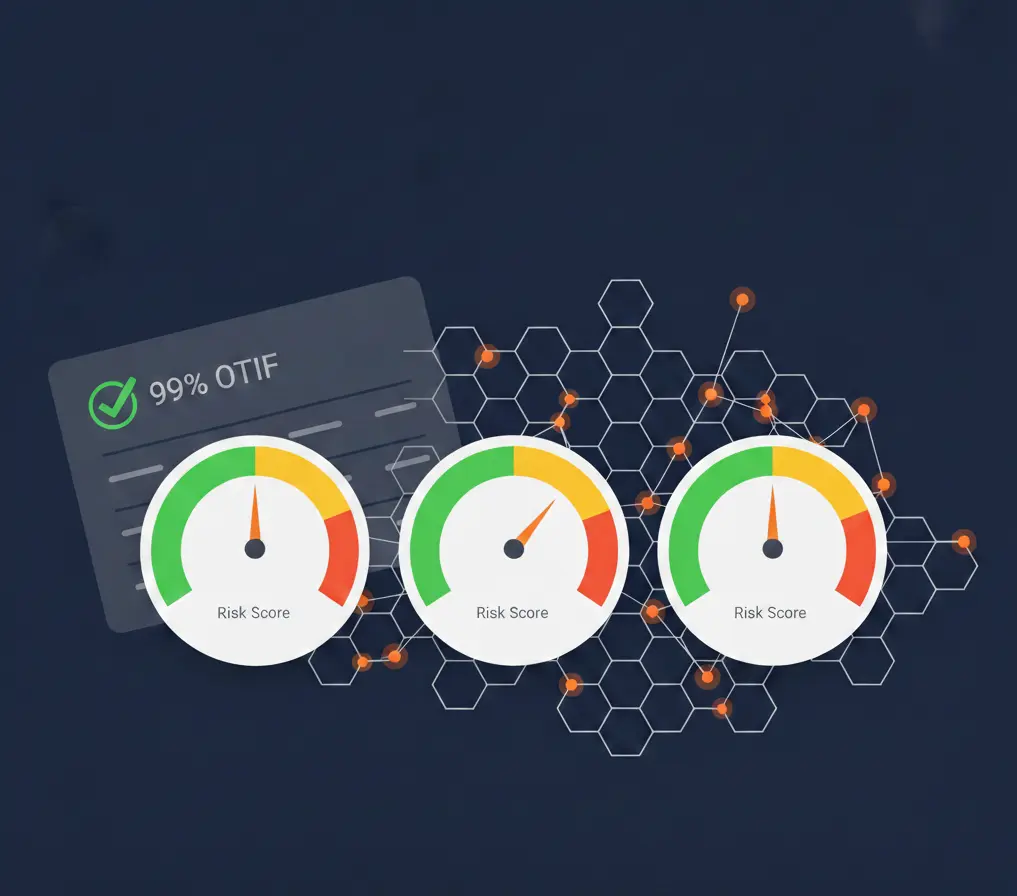
Email-first AI can do more than send messages - it can predict which orders are at risk. This is where Sotro's Supplier Reliability Index (SRI) comes in.
Traditional supplier metrics like OTIF (On-Time, In-Full) tell you after the fact how a supplier performed. SRI is forward-looking. It's designed to answer: "Is this order likely to be late?" early enough for you to take action.
The SRI combines multiple data signals:
- Historical Performance Patterns: Past delivery rates weighted by recency, looking at trends rather than simple averages.
- Communication Latency: How quickly does the supplier acknowledge POs and provide updates? A supplier who requires multiple email chases or gives last-minute confirmations is riskier than one who responds promptly.
- Regional Disruption Signals: Port congestion, weather events, geopolitical risks, labor strikes - factors that could affect delivery even if the supplier hasn't yet missed your order.
The stakes are high. Supply chain disruptions cost companies on average 6-10% of their annual revenue, according to the Economist Intelligence Unit. In manufacturing, the costs are even more acute: Siemens' True Cost of Downtime report found automotive production lines lose up to $2.3 million per hour when idle, with average manufacturing downtime costing $260,000 per hour.
What Is Sotro Copilot?
Sotro Copilot is an AI-powered analyst that runs nightly scans of all open orders. Every morning, it presents your procurement team with a prioritized dashboard: which POs are at risk according to SRI and why.
For example: "PO #98765 - Risk Level: High. Supplier hasn't acknowledged, and regional factory outages reported. Recommended action: expedite or find backup supplier."
Importantly, this is a human-in-the-loop model. The AI Copilot doesn't unilaterally make decisions - it provides insights and drafts actions, but a human procurement manager reviews them. You get an AI-curated to-do list focusing your attention where it's needed most. Instead of combing through hundreds of POs and emails, the AI surfaces the 5 or 10 that need intervention.
You can approve suggested follow-up emails, escalate an issue, or override recommendations if you have better information. The benefit is twofold: earlier detection of problems, and an augmented response. You're not just measuring how badly things went - you're actively managing risk in real time.
What Does This Mean for Procurement Teams?
Adopting email-first AI signals a broader shift in the role of procurement teams.
Friction drops significantly. Instead of policing suppliers to use your system, you remove that tension. Suppliers appreciate the simplicity - you become a "customer of choice" because you're easy to work with.
Your team becomes proactive and strategic. The mundane tasks of chasing POs, updating spreadsheets, and processing status emails are handled by the AI. Buyers can spend their time on higher-value activities: sourcing new suppliers, negotiating better terms, analyzing spend, or working on continuous improvement with key vendors.
You gain visibility and control. Because the AI logs every supplier interaction, you get a real-time picture of order status without having to call around. Risks are flagged early, which means fewer last-minute surprises. And if an issue does escalate, you have the digital paper trail to hold productive conversations.
For the IT and finance folks, an email-first SaaS solution can be easier on budgets and integration efforts. You're not ripping out core systems - you're layering on a lightweight solution that plays nicely with your existing ERP. The risk of implementation failure is much lower than a big bang software project.
Frequently Asked Questions
Do my suppliers need to learn any new portal or software?
No. With an email-first system, suppliers interact through their regular email. The AI platform handles everything on the backend. This is the key to achieving near 100% adoption: there's zero training or onboarding needed on the supplier side.
What if a supplier still doesn't reply to emails?
The AI drafts polite reminder emails at set intervals. If a supplier is completely unresponsive after multiple attempts, the system escalates - alerting your team to call the supplier or CC a secondary contact. No order gets forgotten; the AI agent keeps nudging until there's a response or manual intervention.
How is this different from EDI or our existing procurement system?
Think of email-first AI as a layer on top of your existing systems. It's not replacing your ERP - it's augmenting it by handling communication and data capture automatically. EDI requires heavy IT work on both sides and is only viable for your top few suppliers. Email-first AI works with any supplier out-of-the-box via email, filling the gap for everyone else.
What exactly is the Supplier Reliability Index (SRI)?
SRI is a predictive risk score indicating how likely an order will be fulfilled reliably. It's calculated by analyzing the supplier's past delivery performance, their responsiveness to communications, and external risk signals like regional disruptions. Unlike traditional OTIF metrics that look backward, SRI is forward-looking and continuously updated.
How long does it take to implement an email-first AI solution?
Much faster than a traditional portal. Since you're not rolling it out to suppliers as a user-facing tool, there's no huge change management piece. Most of our customers onboard in under 2 hours. Many teams pilot the system with one category, see results, then expand usage.
Is communicating orders over email secure enough?
Yes - most companies already send POs and order updates via email today. Email-first platforms use secure protocols, and from an audit standpoint, it can be more secure because the AI logs every communication in a central database with full timestamps. You get a better paper trail than when people forward emails around manually.
Who benefits most from an email-first procurement approach?
This approach is especially beneficial for mid-sized to large companies with a diverse supplier base of varying tech maturity. If you don't have the clout to demand all suppliers use a portal - or if you've tried and struggled with adoption - this can be a game-changer. It's also great for lean procurement teams that need to manage hundreds of POs without a large staff.